The 'Agentic' Shift: Why AI Chatbots Are Dead and Agents Are the Future
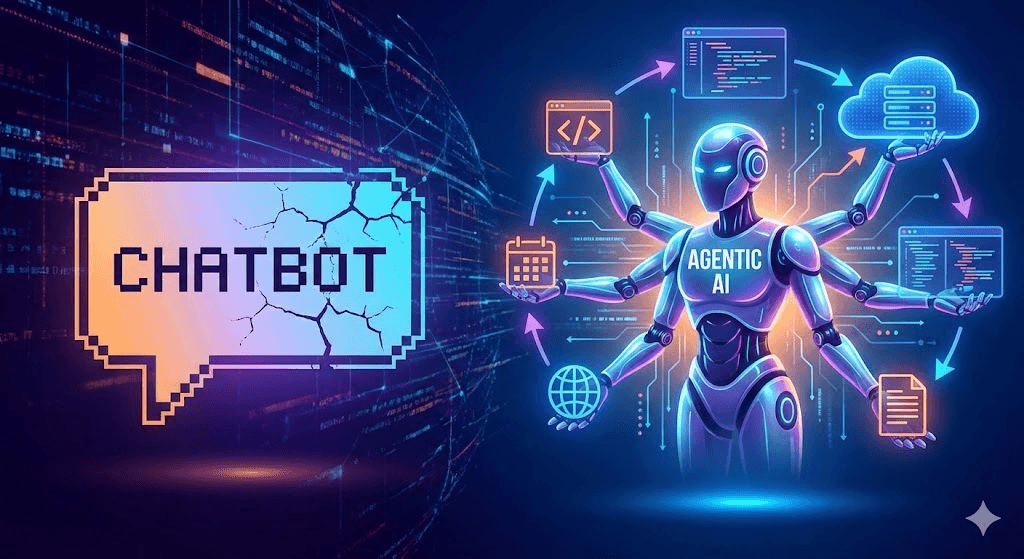
![A visual comparison showing a cracking, pixelated speech bubble labeled 'CHATBOT' on the left, and a sleek, futuristic multi-armed robot labeled 'AGENTIC AI' performing various digital tasks like coding, scheduling, and cloud management on the right. The background is a network of glowing data streams.] "The evolution from passive chatbots to autonomous AI agents."
Remember when the most impressive thing an AI could do was write a poem or summarize an email? That era is officially over. In late 2025, the conversation has shifted from "what can AI say?" to "what can AI do?".
This is the dawn of Agentic AI, a paradigm shift that is making the traditional chatbot model obsolete. We are moving away from tools we talk to and towards digital workers we hire.
The Fundamental Difference: Chat vs. Do
For the past few years, we've been interacting with Large Language Models (LLMs) through a chat interface. You type a prompt, the AI generates text. It’s a passive, one-turn interaction. It’s helpful, but it’s still just a very smart encyclopedia.
Agentic AI is different. An AI agent is designed to be autonomous. It doesn't just answer a question; it takes a goal and executes a series of actions to achieve it.
- Chatbot: "Here is a list of flights to New York."
- AI Agent: "I've found the best flight based on your preferences, booked it using your saved card,
added it to your calendar, and sent a confirmation email to your boss."
The agent can plan, use external tools (like a web browser, code editor, or API), handle errors, and verify its own work. It’s not a conversationalist; it’s a doer.
The Catalyst: Tools That Build Agents
This shift isn't just theoretical. It's being driven by major product releases that are changing how we build software.
A prime example is Google’s Antigravity, the new agent-first IDE (Integrated Development Environment). For decades, developers have used IDEs to write code. Antigravity flips the script: it's an environment for supervising AI agents that write the code for you.
Instead of spending hours debugging a function, a developer can now assign an agent to "fix the bug in the authentication module," and the agent will analyze the codebase, propose a solution, test it, and even deploy the fix—all while the developer focuses on higher-level architecture.
The New Future of Work: Managing a Digital Workforce
The rise of agentic AI is fundamentally changing the definition of "work." We are transitioning from a world where we use software tools to a world where we manage digital employees.
The most valuable skill is no longer just "prompt engineering"—it's agent orchestration. It’s the
ability to:
- Clearly define a complex goal.
- Decompose that goal into tasks for different specialized agents.
- Review and verify the agents' output.
This doesn't mean humans are obsolete. Instead, we are all becoming managers. Our role is shifting from manual execution to strategic oversight, quality control, and creative direction.
Conclusion
The "chatbot" was a necessary stepping stone, a way for us to get comfortable with communicating with machines. But the future belongs to Agentic AI.
The companies and individuals who will thrive in 2026 and beyond are those who stop treating AI as a novelty to chat with and start treating it as a capable, autonomous workforce ready to be deployed. The question is no longer "what can you ask AI?" but "what will you hire AI to do?"