⭐ Introduction
If you're a final-year student in 2025, choosing the right Machine Learning (ML) project can make or break your resume. Recruiters today look for practical, impactful, and deployable projects that show real-world application and technical proficiency.
In the rapidly evolving landscape of artificial intelligence and machine learning, employers are no longer impressed by simple theoretical projects or academic exercises. They want to see that you can take a problem from concept to production, handle data preprocessing challenges, train complex models, and deploy working solutions that solve real problems.
This comprehensive guide lists the Top ML Projects for 2025, complete with detailed descriptions, recommended tech stacks, difficulty levels, implementation tips, and explanations of why they're perfect for your final-year submission and placement success.
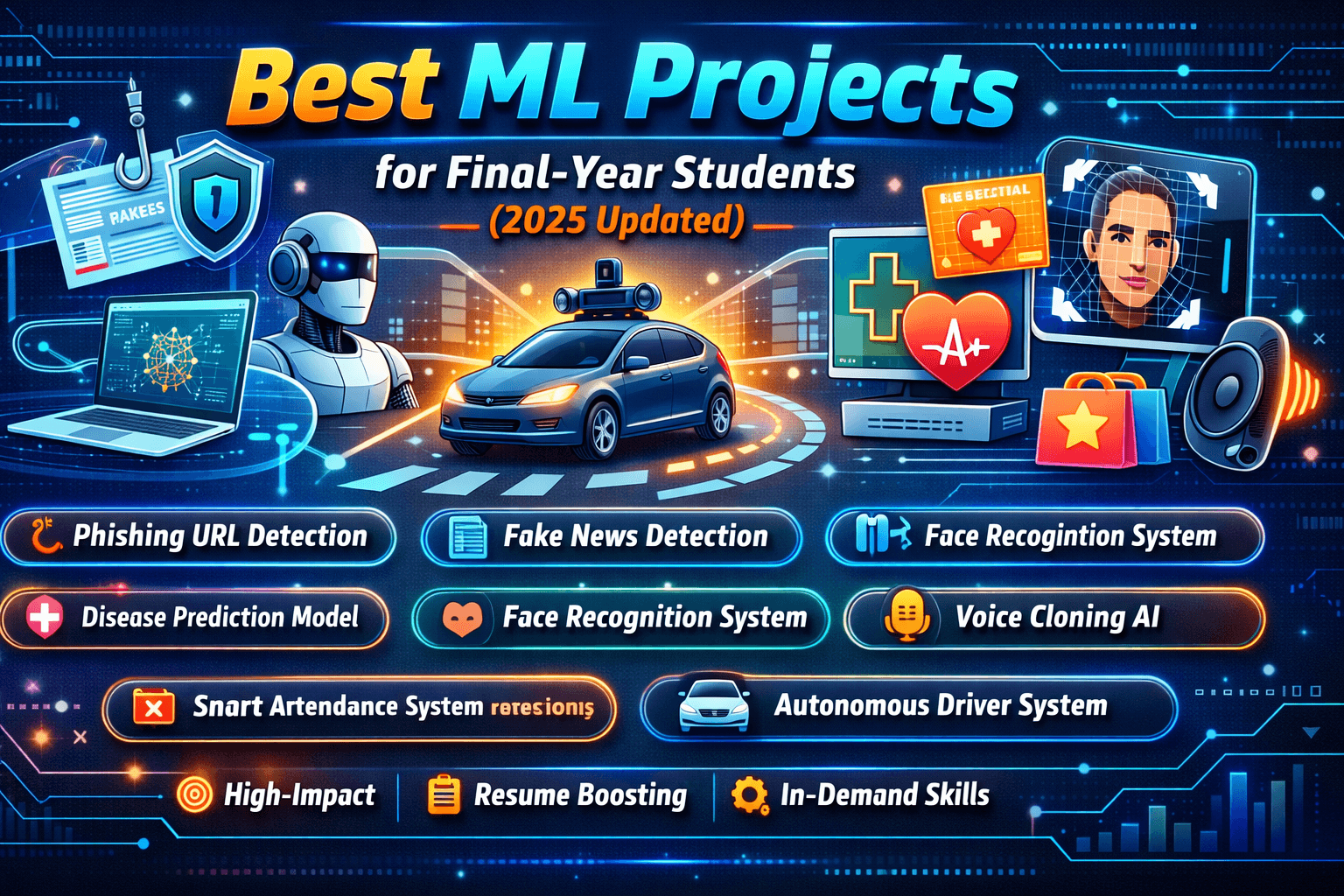
🔥 Best ML Projects for Final-Year Students (2025 Updated)
⭐ 1. AI-Powered Phishing URL Detection System (2025 AI Security Trend)
Project Overview
A cybersecurity-focused machine learning project that detects phishing and malicious websites using URL-based features and deep learning algorithms. This system analyzes the structure, domain properties, and behavioral patterns of URLs to classify them as legitimate or phishing attempts.
How It Works
The system extracts features from URLs such as:
- Domain length and age
- IP address presence
- HTTPS certificate validity
- Suspicious character patterns
- Known phishing domain databases
- URL entropy and randomness indicators
These features are fed into machine learning models (Random Forest, XGBoost, Neural Networks) that have been trained on datasets of known phishing and legitimate URLs.
Why This Project Is Great
- Highly Relevant: Rising cybersecurity threats make this project timely and important
- Extremely Impressive for Recruiters: Security-focused projects stand out in the job market
- Practical Deployment: Can be deployed as a browser extension or API service
- Real Impact: Directly protects users from cyber threats
- Interview Gold: Security and ML combined shows advanced thinking
Tech Stack
Core Libraries: Python, Scikit-learn, TensorFlow/Keras, XGBoost
Additional Tools:
Pandasfor data manipulationNumPyfor numerical operationsRequestsfor URL fetchingStreamlitorFlaskfor deploymentChrome/Firefox APIfor browser extension
Implementation Complexity
Difficulty Level: Medium to Advanced
- Data collection: Easy to Medium
- Feature engineering: Medium
- Model training: Medium
- Deployment: Medium
Expected Results
- Accuracy: 95-99%
- Precision: 94-98%
- Recall: 93-97%
Deployment Options
- Browser Extension - Most impressive
- Standalone Web App with Streamlit
- REST API with Flask/FastAPI
- Chrome/Firefox Add-on
⭐ 2. Fake News Detection using NLP (Transformer Model Edition)
Project Overview
Detect misleading, false, or manipulated news using advanced Natural Language Processing with transformer-based models like BERT, DistilBERT, or RoBERTa. This project combats misinformation by analyzing article content, writing style, and factual accuracy indicators.
How It Works
The system uses transformer models to:
- Analyze semantic meaning and linguistic patterns
- Detect emotional manipulation and sensationalism
- Identify factual inconsistencies
- Compare against credible news sources
- Learn from labeled datasets of real vs. fake news
Why It Works in 2025
- Global Priority: Misinformation and fake news are critical societal challenges
- Advanced NLP Skills: Shows mastery of state-of-the-art transformer models
- Portfolio Impact: AI companies heavily prioritize NLP specialists
- Timely Relevance: Media, social platforms, and governments need this technology
- Real-World Application: Can integrate with news platforms and social media
Tech Stack
Core Libraries: Python, HuggingFace Transformers, PyTorch, Pandas
Additional Tools:
TensorFlow/Kerasfor alternative implementationScikit-learnfor evaluation metricsNLTKfor text preprocessingStreamlitfor web interfaceFastAPIfor API deployment
Implementation Complexity
Difficulty Level: High
- Data collection and cleaning: Medium
- Tokenization and preprocessing: Medium
- Fine-tuning transformer models: High
- Evaluation and optimization: High
- Deployment: Medium
Expected Results
- Accuracy: 85-95%
- F1-Score: 0.83-0.93
- ROC-AUC: 0.90-0.98
Model Options
- BERT (Bidirectional Encoder Representations from Transformers) - Most accurate
- DistilBERT - Faster, lighter version
- RoBERTa - Improved performance
- Albert - Even more efficient
Dataset Recommendations
- LIAR Dataset (14,000+ fact-checked claims)
- Fake News Challenge Dataset
- FEVER Dataset (evidence and reasoning)
- Kaggle Fake News Datasets
⭐ 3. AI Health Assistant – Disease Prediction Model
Project Overview
Predict chronic diseases such as diabetes, heart disease, liver disease, kidney disease, or cancer using medical datasets and machine learning. This healthcare-focused project demonstrates your ability to work with sensitive data and create models with real life-or-death implications.
How It Works
The system analyzes patient health parameters:
- Age, gender, and lifestyle factors
- Blood pressure, cholesterol, glucose levels
- Smoking and alcohol consumption habits
- Family medical history
- Exercise and diet patterns
- Previous health conditions
These factors are processed through trained ML models that predict disease risk and probability.
Why It's Popular
- Highly Academic: Perfect for final-year projects with strong theoretical foundation
- Real-World Use Case: Healthcare industry desperately needs accurate prediction models
- Multiple Datasets Available: Abundant public medical datasets to work with
- Career Relevance: Healthcare AI is a booming industry
- Impressive Portfolio Piece: Shows you can handle sensitive medical data responsibly
- Deployment Ready: Easy to create a web interface for doctor use
Tech Stack
Core Libraries: Python, Machine Learning, Scikit-learn, Pandas
Additional Tools:
NumPyfor numerical operationsMatplotlibandSeabornfor visualizationFlaskorStreamlitfor web deploymentSQLiteorPostgreSQLfor data storagePlotlyfor interactive dashboards
Implementation Complexity
Difficulty Level: Easy to Medium
- Data collection: Easy
- Data preprocessing: Medium
- Model training: Easy to Medium
- Evaluation: Easy to Medium
- Deployment: Easy
Expected Results
- Accuracy: 80-95%
- Precision: 0.80-0.93
- Recall: 0.78-0.92
- Specificity: 0.85-0.96
Dataset Options
- UCI Machine Learning Repository - Multiple medical datasets
- Kaggle - Heart Disease, Diabetes, Breast Cancer datasets
- CDC Health Data - Real population data
- MIMIC-III - ICU patient records
Disease Prediction Options
- Diabetes Prediction (easiest, most datasets)
- Heart Disease Prediction (balanced difficulty)
- Liver Disease Prediction (medium difficulty)
- Cancer Risk Assessment (advanced)
⭐ 4. Smart Attendance System using Face Recognition (Real-Time)
Project Overview
A real-time attendance system that automatically marks attendance by recognizing student/employee faces using computer vision and deep learning. This project combines facial detection, recognition, and real-time processing into a practical system.
How It Works
The system operates in several stages:
1. Face Detection: Identifies human faces in camera frames using MTCNN or RetinaFace
2. Face Encoding: Extracts unique facial features using FaceNet or VGGFace
3. Face Recognition: Compares detected faces against a database of enrolled faces
4. Attendance Logging: Automatically records attendance with timestamp and confidence score
5. Real-Time Display: Shows live feed with recognized names and attendance status
Why It Works
- Practical College Implementation: Can be deployed in actual classrooms immediately
- Involves Hardware & Vision: Shows full computer vision pipeline understanding
- Shows Complete ML Pipeline: Data collection → preprocessing → model building → deployment
- Hardware Integration: Works with webcams, CCTV, or IP cameras
- Real-Time Processing: Demonstrates optimization and speed considerations
- Impressive Demo: Visual projects always impress examiners and recruiters
Tech Stack
Core Libraries: Python, OpenCV, TensorFlow, Keras
Computer Vision Tools:
OpenCVfor image processing and camera handlingFaceNetorVGGFace2for face encodingMTCNNfor face detectionDlibfor facial landmarksscikit-learnfor classification
Deployment Tools:
Streamlitfor web interfaceFlaskfor REST APISQLitefor attendance databaseMySQLfor scalable deployment
Implementation Complexity
Difficulty Level: High
- Face detection model: Medium
- Face recognition model: High
- Real-time processing: High
- Database integration: Medium
- Deployment: Medium to High
Expected Results
- Face Detection Accuracy: 95-99%
- Face Recognition Accuracy: 90-99%
- Real-time FPS: 20-30 frames per second
- System Reliability: 98%+
Model Options
- FaceNet + MTCNN - Most accurate
- VGGFace2 + RetinaFace - Best balance
- OpenFace + Dlib - Lightweight
- Facenet512 + Mediapipe - Fast and accurate
Deployment Variations
- Webcam-based (for lab/demo)
- CCTV/IP Camera integration
- Mobile-based using TensorFlow Lite
- Edge device (Raspberry Pi, Jetson Nano)
⭐ 5. Movie/Shopping Recommendation System (Hybrid Model)
Project Overview
A personalized recommendation system that suggests movies or products to users by combining collaborative filtering (what similar users like) and content-based filtering (item similarity). This system learns user preferences and makes intelligent recommendations.
How It Works
Collaborative Filtering Approach:
- Analyzes user-item interaction patterns
- Identifies similar users based on rating history
- Recommends items liked by similar users
- Uses matrix factorization techniques
Content-Based Filtering Approach:
- Analyzes item features (genre, director, price, category)
- Finds items similar to user's previously liked items
- Recommends based on item-to-item similarity
Hybrid Approach:
- Combines both methods for more accurate recommendations
- Handles cold-start problems (new users/items)
- More robust and scalable
Why Choose This?
- Recruiter Favorite: Recommendation systems are core to every tech company
- Great for ML Interviews: Standard interview topic at FAANG companies
- Scalable: Can handle thousands of users and items
- Business Value: Directly increases revenue and user engagement
- Multiple Algorithms: Showcase knowledge of various ML techniques
- Real-World Application: Netflix, Amazon, YouTube all use similar systems
Tech Stack
Core Libraries: Python, Pandas, NumPy, Scikit-learn
Recommendation-Specific Tools:
Surpriselibrary for collaborative filteringCosine Similarityfor content-based filteringTensorFlowfor neural collaborative filteringImplicitfor implicit feedback recommendation
Deployment & Visualization:
Streamlitfor interactive web appFlaskfor APIMongoDBfor user/item storageRedisfor caching recommendations
Implementation Complexity
Difficulty Level: Medium
- Data collection and preparation: Easy to Medium
- Collaborative filtering implementation: Medium
- Content-based filtering implementation: Medium
- Hybrid system design: Medium to High
- A/B testing and evaluation: Medium
- Deployment: Easy to Medium
Expected Results
- Precision@K: 0.70-0.85
- Recall@K: 0.60-0.80
- RMSE: 0.8-1.2
- Coverage: 80-95%
- Diversity: Good (hybrid approach)
Dataset Options
- MovieLens Dataset (most popular for recommendations)
- Amazon Product Reviews
- Spotify Million Playlist Dataset
- Kaggle E-commerce Datasets
Recommendation Algorithms to Implement
- User-Based Collaborative Filtering
- Item-Based Collaborative Filtering
- Matrix Factorization (SVD)
- Neural Collaborative Filtering
- Content-Based Filtering
- Hybrid Approach (combination)
⭐ 6. Voice Cloning with Deep Learning (Advanced)
Project Overview
Clone human voice and generate natural-sounding speech using advanced deep learning models. This cutting-edge project combines text-to-speech synthesis with voice character preservation, enabling realistic voice generation from minimal audio samples.
How It Works
Text-to-Speech (TTS) Pipeline:
- Text Processing: Parse and normalize input text
- Mel-Spectrogram Generation: Use Tacotron2 to convert text to mel-spectrograms
- Waveform Synthesis: Convert spectrograms to audio using WaveGlow or WaveNet
- Voice Cloning: Train on target speaker samples to preserve voice characteristics
Voice Encoding:
- Extract unique voice characteristics from reference audio
- Use speaker embeddings (i-vectors or x-vectors)
- Condition TTS model on target speaker
Why It's Trending
- AI Voice Becoming Huge: YouTube, gaming, virtual assistants, podcasting all need realistic voices
- Deep Learning Mastery: Shows advanced understanding of neural networks
- Audio ML Knowledge: Demonstrates signal processing and audio engineering skills
- Emerging Industry: Voice AI startups and companies desperately need this skill
- Impressive Demo: Audio generation is always captivating and impressive
- Multiple Applications: Audiobooks, gaming, accessibility tech, entertainment
Tech Stack
Core Libraries: Python, PyTorch, TensorFlow, NumPy
Audio Processing Tools:
Librosafor audio loading and processingMel Spectrogramsfor audio feature extractionScipyfor signal processingSoundfilefor audio I/O
Deep Learning Models:
Tacotron2for text-to-speechWaveGlowfor waveform synthesis (fast)WaveNetfor high-quality audioFastSpeech2for faster inferenceGlow-TTSfor improved quality
Deployment Tools:
Streamlitfor web interfaceFlaskwith background workersDockerfor containerizationAWSorGCPfor cloud deployment
Implementation Complexity
Difficulty Level: Very High / Advanced
- Audio preprocessing: Medium
- Mel-spectrogram extraction: Medium
- Tacotron2 architecture understanding: High
- WaveGlow/WaveNet implementation: Very High
- Fine-tuning for voice cloning: High
- Real-time inference optimization: Very High
- Deployment and scaling: High
Expected Results
- MOS (Mean Opinion Score): 4.0-4.5/5.0
- Speaker similarity: 0.85-0.95
- Naturalness: High
- Inference speed: 5-10x real-time
Pre-trained Models Available
- NVIDIA Tacotron2 + WaveGlow
- FastSpeech2 + HiFi-GAN
- Glow-TTS + WaveGlow
- Parallel WaveGAN
- YourTTS (transfer learning for voice cloning)
Dataset Requirements
- Target Speaker Audio: 10 minutes to 1 hour of clean audio
- General TTS Training: LJSpeech or VCTK datasets
- Multi-speaker: VCTK or LibriTTS for better generalization
Real-World Applications
- Audiobook Narration - Clone author's voice
- Gaming - Character voice generation
- Virtual Assistants - Personalized voice
- Accessibility - Voice for speech-impaired
- Content Creation - Podcast automation
- Entertainment - Celebrity voice simulation
⭐ 7. Autonomous Driver Assistance System (ADAS Mini Model)
Project Overview
Build a mini autonomous driving system that combines multiple computer vision tasks: road sign detection, lane detection, and steering prediction. This comprehensive project demonstrates your ability to integrate multiple deep learning models into a cohesive system.
How It Works
Road Sign Detection:
- Detects and classifies traffic signs (speed limit, stop, yield, etc.)
- Uses YOLO or Faster R-CNN for real-time detection
- Alerts driver to critical signs
- High accuracy and speed critical
Lane Detection:
- Identifies road lanes from camera feed
- Detects lane boundaries using edge detection and Hough transform
- Computes vehicle position relative to lane center
- Alerts driver to lane departure
Steering Prediction:
- Predicts optimal steering angle based on road state
- Uses CNN to learn from driving data
- Provides autonomous steering recommendations
- Can integrate with vehicle control systems
Integration:
- Combines all three subsystems
- Real-time processing from video feed
- Dashboard showing detections and predictions
- Safety alerts and recommendations
Why This Is Impressive
- Robotics + ML Combo: Powerful combination that impresses tech companies
- Complex Integration: Shows ability to combine multiple models
- Real-Time Processing: Demonstrates optimization skills
- Computer Vision Mastery: Full range of CV techniques
- Safety-Critical: Shows understanding of reliability and correctness
- Awesome Demo: Can showcase with actual vehicle or simulator
- Industry-Relevant: Autonomous vehicles are the future
Tech Stack
Core Libraries: Python, OpenCV, TensorFlow, Keras, PyTorch
Computer Vision Models:
YOLO v5/v8for road sign detectionFaster R-CNNorSSDfor alternative detectionOpenCVfor lane detection and image processingCNNfor steering angle prediction
Additional Tools:
NumPyfor numerical operationsPandasfor data handlingMatplotlib/Plotlyfor visualizationStreamlitfor web interfaceFlaskfor API deployment
Simulation & Testing:
CARLA Simulatorfor autonomous drivingOpenAI Gymwith driving environments- Real vehicle or RC car with camera
Implementation Complexity
Difficulty Level: Advanced
- Road sign detection: Medium to High
- Lane detection: Medium
- Steering prediction: High
- System integration: High
- Real-time optimization: Very High
- Deployment: Medium to High
Expected Results
Road Sign Detection:
- Accuracy: 92-98%
- mAP (mean Average Precision): 0.85-0.95
Lane Detection:
- Accuracy: 95-99%
- False positive rate: <5%
Steering Prediction:
- MAE (Mean Absolute Error): 0.5-2 degrees
- Correlation: 0.85-0.95
Overall System:
- FPS (Frames Per Second): 15-30
- Latency: 30-60ms
Dataset Options
- KITTI Dataset - Largest autonomous driving dataset
- Udacity Self-Driving Car Dataset
- Cityscapes - Urban street scene dataset
- BDD100K - Diverse driving video dataset
- Custom Dataset - Record your own with phone/camera
Deployment Options
- Simulation-based (CARLA, driving game)
- Video-based (process video files)
- Webcam/Camera-based (real-time)
- RC Car Integration (actual hardware)
- Embedded System (Jetson Nano, Pi)
💡 Pro Tips for Final-Year Students
🎓 Choosing a Project that Impresses
Make it Deployable: Choosing a project that is deployable online using Streamlit, Flask, or FastAPI will dramatically boost your resume and impress examiners. A deployed, working system is far more impressive than code on GitHub.
Live Demo: Show a working version during your viva/presentation. This is crucial. Examiners and recruiters want to see your project in action.
End-to-End Pipeline: Show your complete pipeline: data collection → preprocessing → model training → evaluation → deployment. This demonstrates maturity and understanding.
Real-World Data: Use actual datasets or real-world data when possible. Synthetic or toy datasets are less impressive.
Document Everything: Write clear documentation, README files, and explain your decisions. Good documentation is often overlooked but highly valued.
📊 Data Collection Tips
- Use Public Datasets: Kaggle, UCI ML Repository, GitHub datasets
- Web Scraping: Collect data yourself using Selenium or BeautifulSoup
- API Integration: Use public APIs (Twitter, Reddit, etc.)
- Real-World Sources: Get data from actual production scenarios
- Data Quality: Ensure good data quality; garbage in = garbage out
🔬 Model Training Best Practices
- Start Simple: Begin with simple models, then progress to complex ones
- Baseline Model: Always establish a baseline for comparison
- Hyperparameter Tuning: Optimize your model systematically
- Cross-Validation: Use k-fold or stratified validation
- Track Metrics: Monitor loss, accuracy, precision, recall, F1, etc.
- Prevent Overfitting: Use regularization, dropout, early stopping
🚀 Deployment Checklist
- Streamlit: Easiest for quick demos (no frontend needed)
- Flask: Good for APIs and more control
- FastAPI: Modern, fast alternative to Flask
- Docker: Package your app for consistency
- Cloud Hosting: Deploy on Heroku, AWS, GCP, or Azure
- Mobile: Consider TensorFlow Lite for mobile deployment
📊 Comparison Table: Best Final-Year ML Projects (2025)
| Project | Difficulty | Hiring Impact | Deployment Possible | Best For | |---------|-----------|---------------|--------------------|----------| | Phishing Detection | Medium | ⭐⭐⭐⭐⭐ | Yes - Browser Ext/API | Security Focus | | Fake News NLP | High | ⭐⭐⭐⭐ | Yes - Web App | NLP Specialists | | Health Prediction | Easy | ⭐⭐⭐⭐ | Yes - Web Interface | Quick Project | | Face Recognition | High | ⭐⭐⭐⭐⭐ | Yes - Real-time App | CV Focus | | Recommendation System | Medium | ⭐⭐⭐⭐ | Yes - Web/Mobile | Product Thinking | | Voice Cloning | Very High | ⭐⭐⭐⭐⭐ | Challenging | Advanced ML | | ADAS System | Advanced | ⭐⭐⭐⭐⭐ | Yes - Simulation | Robotics/CV |
🎯 Choosing the Right Project For You
Choose Phishing Detection If:
- You're interested in cybersecurity
- You want impressive recruiter feedback
- You prefer balanced project scope
- You want to deploy a browser extension
- You have medium time and resources
Choose Fake News Detection If:
- You're passionate about NLP and linguistics
- You want to showcase transformer model knowledge
- You aim for top-tier NLP roles
- You enjoy text analysis and language understanding
- You can handle complexity
Choose Health Prediction If:
- You want to complete project quickly
- You prefer tabular data over images/text
- You're interested in healthcare/medtech
- You want an easy-to-explain project
- You need something academic and solid
Choose Face Recognition If:
- You're passionate about computer vision
- You want the most impressive real-time demo
- You have access to cameras/hardware
- You're targeting vision-heavy roles
- You enjoy seeing visual results
Choose Recommendation System If:
- You're aiming for product/data roles
- You want interview-friendly project
- You're interested in building scalable systems
- You like working with user behavior data
- You aim for FAANG companies
Choose Voice Cloning If:
- You're highly advanced in deep learning
- You're interested in audio/speech AI
- You want cutting-edge technology
- You're aiming for AI research roles
- You have significant time for complexity
Choose ADAS If:
- You're passionate about autonomous vehicles
- You want to showcase multiple integrated models
- You're interested in robotics
- You can invest in hardware (RC car, Jetson)
- You want the most impactful real-world application
📌 Final Thoughts & Action Plan
For 2025, machine learning engineering is all about real-world impact, scalability, and deployment.
Characteristics of a Winning Final-Year ML Project:
✅ Solves an Actual Problem — Not just an academic exercise
✅ Can Be Deployed — Live, working system accessible to others
✅ Uses Modern Algorithms — Transformers, CNNs, XGBoost, advanced techniques
✅ Shows Complete Pipeline — Data preprocessing → model building → evaluation → deployment
✅ Impressive Demo — Can visually demonstrate results during viva
✅ Well-Documented — Clear code, README, and explanations
✅ Scalable Architecture — Designed to handle growth
✅ Production-Ready — Error handling, logging, monitoring
Your 6-Month Action Plan:
Month 1-2: Planning & Data Collection
- Choose your project based on your interests and strengths
- Research existing solutions and datasets
- Collect and explore your data
- Perform initial data analysis
Month 2-3: Development & Training
- Set up development environment
- Implement data preprocessing pipeline
- Train baseline and advanced models
- Perform hyperparameter tuning
Month 3-4: Optimization & Evaluation
- Optimize model performance
- Implement cross-validation
- Compare multiple algorithms
- Document all results and metrics
Month 4-5: Deployment
- Build web interface (Streamlit/Flask)
- Deploy to cloud platform
- Set up monitoring and logging
- Test extensively for bugs
Month 5-6: Polish & Presentation
- Create comprehensive documentation
- Prepare presentation and demo
- Write detailed report
- Create GitHub repository with full code
Success Metrics:
- ✓ Model accuracy/performance meets expectations
- ✓ Project deployed and accessible online
- ✓ Smooth, impressive live demo
- ✓ Complete documentation and code
- ✓ Clear presentation to examiners
- ✓ Positive recruiter feedback during placements
🌟 Remember
The goal of your final-year ML project isn't just to pass the course—it's to build a portfolio piece that gets you hired. Focus on impact, deployability, and real-world relevance.
Whether you choose security, healthcare, entertainment, autonomous vehicles, or any other domain, make sure your project:
- Demonstrates complete ML knowledge
- Shows practical implementation skills
- Can be presented as a working system
- Solves a meaningful problem
Start today. Build something amazing. Change your career trajectory.
The best time to start was last semester. The second best time is right now. Your future self will thank you for choosing wisely and executing excellently.
Happy coding, and good luck with your ML journey!