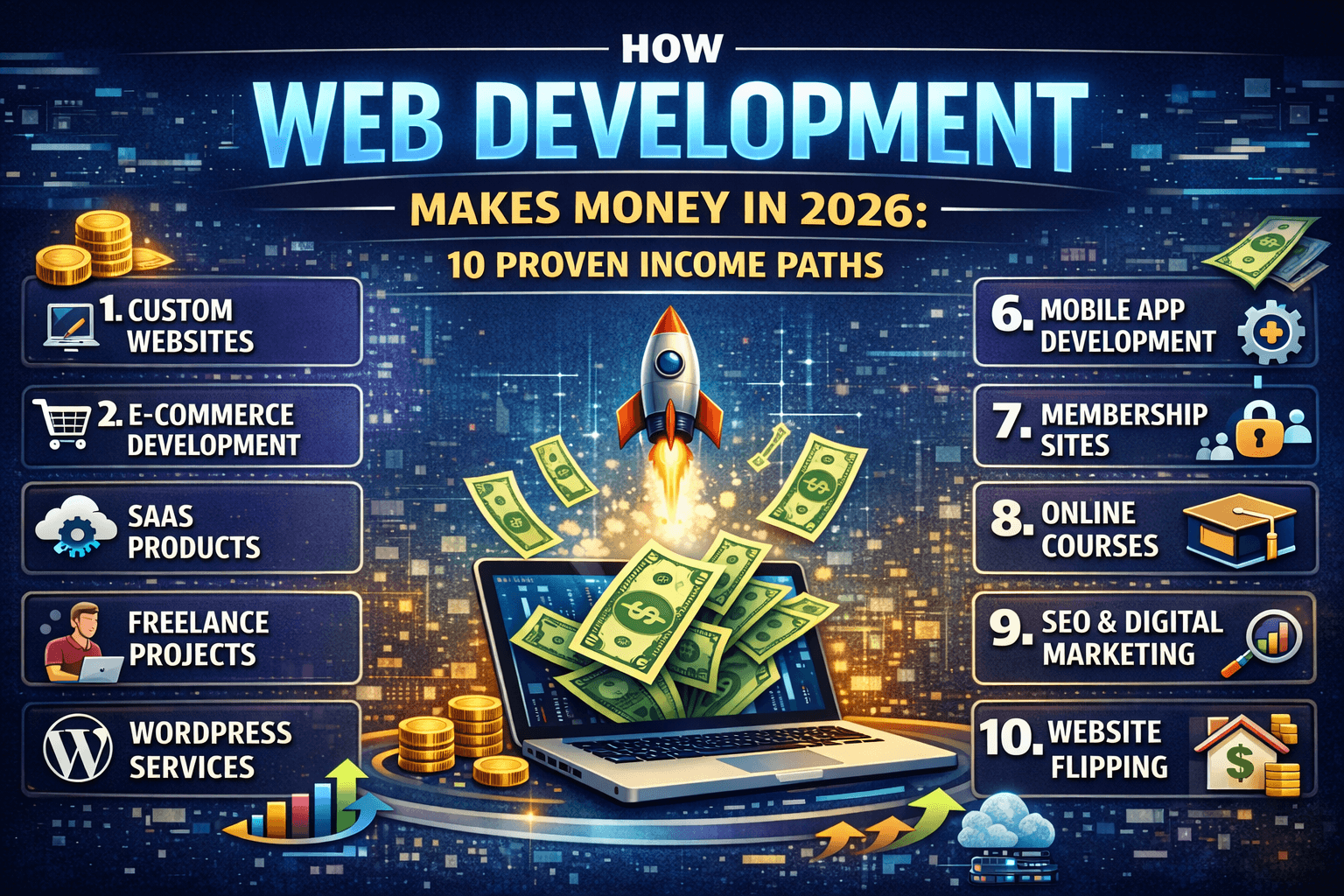
How Web Development Makes Money in 2026: 10 Proven Income Paths
If you are searching for how web development makes money in 2026, this guide gives you a practical framework you can apply immediately. In 2026, the winners are not the people who consume more content. The winners are the people who package value clearly and execute consistently.
Web development remains one of the most profitable digital skills, with developers earning between $3,000 to $20,000+ monthly depending on their income model and positioning. This comprehensive guide breaks down 10 proven methods with real implementation strategies.
Why This Matters in 2026
Market competition is higher, AI tools are faster, and clients expect outcomes instead of vague promises. That means web developers who combine delivery quality with positioning and distribution can grow faster than ever.
The landscape has shifted dramatically. AI assistants can generate basic code, no-code platforms allow anyone to build simple sites, and clients are more educated about what they need. Your competitive advantage now lies in specialized expertise, business understanding, and reliable execution.
The 10 Proven Income Paths for Web Developers
1. High-Ticket Client Projects ($3,000-$15,000 per project)
This model focuses on selling complete website solutions to businesses willing to invest in quality. Target mid-sized businesses, established service providers, and growing e-commerce brands.
What to offer:
- Custom business websites with conversion optimization
- E-commerce platforms with payment integration
- Brand redesigns with improved user experience
- Performance audits and optimization services
How to price: Start with $3,000-$5,000 for basic business sites, scale to $8,000-$15,000 for complex builds with custom features, integrations, and ongoing optimization.
Where to find clients: Use LinkedIn outreach targeting business owners in profitable niches like legal services, healthcare, real estate, and professional consulting. Apply to curated job boards like We Work Remotely and Gun.io. Leverage warm referrals from existing clients.
2. Monthly Retainer Agreements ($500-$3,000/month)
Retainers provide predictable recurring revenue. You maintain, update, and support client websites for a fixed monthly fee.
Services included:
- Security updates and plugin maintenance
- Content updates and page additions
- Performance monitoring and optimization
- Technical support and troubleshooting
- Monthly analytics reporting
Client acquisition strategy: Convert project clients into retainer relationships by demonstrating the risk of neglected websites. Target businesses managing dynamic content, running active marketing campaigns, or operating in regulated industries.
Pricing tiers: Basic maintenance at $500-$800/month, active support at $1,200-$2,000/month, and comprehensive management at $2,500-$3,000/month.
3. Building and Selling SaaS Products
Create software-as-a-service tools that solve recurring problems for specific audiences. This path requires upfront investment but offers scalable income.
Profitable micro-SaaS ideas for 2026:
- AI-powered content schedulers for specific platforms
- Niche CRM systems for specialized industries
- Booking and appointment systems with unique features
- Analytics dashboards for specific business types
- Workflow automation tools for particular professions
Development approach: Build the minimum viable product in 30-60 days using modern frameworks like Next.js, React, or Laravel. Focus on solving one specific pain point exceptionally well rather than building broad functionality.
Monetization: Charge $29-$199/month per user depending on value delivered. Target 50-100 paying customers in year one, scaling to 500+ in year two.
4. WordPress and Shopify Theme Development
Create premium themes for popular platforms and sell them on marketplaces or directly.
Revenue potential: Successful themes generate $1,000-$5,000+ monthly in passive income after initial development. Top sellers on ThemeForest earn $10,000-$50,000+ monthly.
Development focus: Build themes for specific niches rather than generic templates. Examples include real estate listing themes, restaurant booking themes, fitness studio themes, or medical practice themes.
Distribution channels: Sell on ThemeForest, Creative Market, or your own website. Price between $49-$149 for premium themes.
5. E-commerce Development Specialist
Position yourself as an expert in building and optimizing online stores. E-commerce projects command premium pricing due to their revenue-generating nature.
Specialized services:
- Shopify store setup and customization
- WooCommerce complex builds
- Headless commerce implementations
- Payment gateway integrations
- Inventory management system connections
Client targeting: Focus on product businesses scaling from $100,000 to $1 million in annual revenue. These companies need professional stores but aren't ready for enterprise solutions.
Pricing structure: Charge $5,000-$20,000 for complete store builds, plus 10-20% of monthly revenue for ongoing conversion rate optimization services.
6. AI-Powered Web Services
Integrate AI capabilities into traditional web development offerings to command premium rates and differentiate from competitors.
High-demand AI integrations:
- Chatbots with natural language understanding
- Personalized content recommendation engines
- AI-powered search functionality
- Automated customer support systems
- Dynamic pricing tools
- Content generation and optimization
Implementation approach: Use APIs from OpenAI, Anthropic, or Google to add AI features without building models from scratch. Package these as premium add-ons to standard websites.
Pricing premium: Add $2,000-$8,000 to project costs for meaningful AI integration. Charge ongoing fees for API usage and maintenance.
7. Website Speed and Performance Optimization
Specialize in making slow websites fast. This is a high-value service as site speed directly impacts revenue and search rankings.
Service delivery: Audit website performance using tools like Google PageSpeed Insights, GTmetrix, and WebPageTest. Optimize images, implement caching, minify code, use CDNs, and refactor inefficient code.
Target market: E-commerce sites losing sales to slow load times, content sites with declining traffic due to Core Web Vitals issues, and SaaS platforms with user experience complaints.
Pricing model: Charge $1,500-$5,000 per optimization project based on site complexity. Offer monthly monitoring retainers at $300-$800/month.
8. No-Code/Low-Code Platform Consulting
Help businesses leverage platforms like Webflow, Bubble, or Framer to build solutions faster and more cost-effectively.
Why this works in 2026: Businesses want speed and flexibility. No-code platforms deliver both when implemented correctly by an expert who understands limitations and possibilities.
Service offerings:
- Platform selection consulting
- Custom builds on chosen platforms
- Integration with existing tools
- Training and handoff
- Ongoing optimization
Client profile: Startups needing MVPs quickly, established businesses running experiments, and marketing teams wanting independence from development bottlenecks.
Revenue model: Charge $50-$150/hour for consulting, $3,000-$10,000 for complete builds, and $800-$2,000/month for optimization retainers.
9. Technical Content Creation and Education
Monetize your expertise through educational content including courses, tutorials, technical writing, and coaching.
Income streams:
- Online courses on platforms like Udemy, Teachable, or your own site
- YouTube ad revenue and sponsorships
- Technical blog with affiliate income
- Paid newsletters and memberships
- One-on-one coaching or group programs
Content topics that sell: Specific framework tutorials, niche technology deep-dives, career transition guides, freelancing business strategies, and emerging technology overviews.
Building approach: Start with free content to build audience, validate interest in specific topics, then create premium offerings around proven demand.
Revenue timeline: Expect 6-12 months to build meaningful income, with potential to reach $2,000-$10,000+ monthly with consistent effort.
10. White Label Development for Agencies
Partner with marketing agencies, design studios, and consultancies that sell web services but lack in-house development capacity.
How it works: Agencies sell projects to their clients, you build the websites, agencies mark up your work and manage client relationships. You focus purely on development.
Advantages: Consistent project flow without marketing effort, clear specifications from experienced agencies, and predictable payment terms.
Finding partners: Network in local business communities, join agency directories, attend marketing conferences, and leverage LinkedIn to connect with agency owners.
Pricing approach: Charge 50-70% of typical retail rates. Accept lower margins in exchange for steady volume and reduced client management.
Core Strategy Framework
Regardless of which income path you choose, follow this universal framework:
1. Pick One Niche and One Painful Problem
Don't be a generalist competing on price. Specialize in serving one type of client exceptionally well. Examples include real estate agents needing lead generation sites, medical practices wanting HIPAA-compliant patient portals, or SaaS companies needing marketing websites that convert.
2. Build One Clear Offer with Fixed Scope
Create a specific package with defined deliverables, timeline, and outcomes. Avoid open-ended "we build websites" positioning. Instead, offer "30-day restaurant website launch with online ordering integration" or "e-commerce conversion audit with implementation roadmap."
3. Show Proof Through Case Studies
Demonstrate results with before-and-after examples, client testimonials with specific outcomes, recorded walkthroughs of your projects, and quantified improvements in metrics like conversion rates, page speed, or revenue.
4. Run a Repeatable Lead Generation System
Choose one primary channel and master it. Options include daily LinkedIn outreach to decision-makers, SEO-optimized content attracting inbound leads, strategic partnerships with complementary service providers, or paid advertising on platforms where your clients spend time.
5. Improve Delivery Speed and Reliability
Build systems to deliver consistent quality faster. Create project templates and starter kits, document repeatable processes, use project management tools effectively, and automate routine tasks where possible.
SEO + AEO Optimization Blueprint
To rank in search engines and appear in AI-powered answer engines, implement these strategies:
Use direct problem-based headings: Structure content around questions your audience actually searches. Examples include "How much do web developers charge in 2026?" and "What is the fastest way to get web development clients?"
Answer key questions early: Provide immediate value in opening paragraphs. AI answer engines prioritize content that directly addresses user intent without unnecessary preamble.
Include actionable steps and examples: Generic advice doesn't rank well. Specific implementation details, real pricing numbers, and tactical steps perform better in both traditional search and AI summaries.
Keep paragraphs concise and scannable: Use 2-4 sentence paragraphs, clear transitions, and descriptive subheadings. This improves readability for humans and parseability for AI.
Add a comprehensive FAQ section: Answer common related questions to capture long-tail search traffic and feature snippet opportunities.
Practical 90-Day Execution Plan
Days 1-30: Foundation Phase
Week 1-2: Market Research and Positioning
- Identify three potential niches based on your existing experience and market demand
- Research competition, pricing, and pain points in each niche
- Choose one niche and define your specific offer
- Create a simple one-page website or portfolio profile
Week 3-4: Proof Asset Creation
- Build one demo project showcasing your best work
- Write two detailed case studies if you have past projects
- Record a video walkthrough explaining your process
- Collect testimonials from any previous clients or colleagues
Days 31-60: Acquisition Phase
Daily outreach or content publishing:
- Send 10-20 personalized outreach messages daily on LinkedIn
- Publish one in-depth blog post or video tutorial weekly
- Engage in relevant online communities without spamming
- Follow up systematically with interested prospects
Weekly improvement cycle:
- Review which messages get responses and refine your pitch
- Track conversion rates from initial contact to paid project
- Adjust pricing based on market feedback
- Identify and address common objections
Milestone target: Close your first 2-3 paid opportunities by day 60. These might be smaller projects, but they validate your offer and provide additional proof assets.
Days 61-90: Optimization Phase
Process standardization:
- Document your project workflow step-by-step
- Create templates for common deliverables
- Build a client onboarding system
- Establish clear communication protocols
Revenue expansion:
- Offer maintenance retainers to completed clients
- Identify upsell opportunities in your existing process
- Raise prices by 20-30% for new clients based on proven results
- Test different package offerings
Scaling foundation:
- Consider if you need contractors for overflow work
- Evaluate tools that improve efficiency
- Plan your next 90-day growth phase
Common Mistakes to Avoid
Targeting Everyone
Trying to serve all types of clients dilutes your message and makes marketing nearly impossible. A developer who specializes in "websites for dental practices" will win against a generalist every time when dental practices are shopping.
Competing Only on Low Price
The bottom of the market is crowded, margins are terrible, and clients are difficult. Position on value, outcomes, and expertise rather than being the cheapest option available.
Building Before Validation
Don't spend months building a SaaS product or theme without confirming people will pay for it. Sell the concept first, then build. Use landing pages, pre-orders, or consulting engagements to validate demand.
Ignoring Onboarding and Communication
Technical skill alone doesn't create successful projects. Set clear expectations, communicate proactively, manage scope carefully, and deliver on time. Many developers lose clients due to poor communication rather than poor code.
Failing to Track Conversion Metrics
You can't improve what you don't measure. Track how many prospects you contact, what percentage respond, how many become clients, average project value, and time to close. Optimize the weakest points in your funnel.
Key Metrics to Track Weekly
Lead volume: How many new potential clients entered your pipeline this week through all sources?
Conversion rate: What percentage of prospects become paying clients? Industry average is 10-30% for qualified leads.
Average project value: Is this number increasing as you refine positioning and pricing?
Retention/renewal rate: For retainer and SaaS models, what percentage of clients stay month-over-month?
Client outcome quality: Are clients achieving their goals? This drives referrals and testimonials.
Personal income: Track monthly revenue, profit margins, and effective hourly rate to ensure you're moving toward your goals.
Advanced Growth Strategies
Building Strategic Partnerships
Partner with complementary service providers who serve your target market. For example, if you build websites for restaurants, partner with food photographers, menu designers, and restaurant marketing consultants. Create mutual referral agreements.
Creating Service Ladders
Develop multiple price points to capture different segments. Offer a basic package at $3,000, a premium package at $7,000, and an enterprise package at $15,000+. This increases average transaction value and gives prospects choices.
Implementing Value-Based Pricing
Move beyond hourly or project-based pricing to pricing based on client outcomes. If your website generates $50,000 in additional annual revenue for a client, charging $10,000 instead of $5,000 is justified and more profitable.
Building Productized Services
Standardize your offering into repeatable packages. This reduces decision fatigue for clients, speeds up sales cycles, and allows you to systemize delivery for better margins.
Tools and Resources for 2026
Project management: ClickUp, Notion, or Asana for organizing client work and internal processes.
Design: Figma for collaborative design work, mockups, and client presentations.
Development: Modern frameworks like Next.js, React, Vue, or Svelte for frontend development. Tailwind CSS for rapid styling.
AI integration: OpenAI API, Anthropic Claude API, or Google Gemini for adding intelligence to websites.
Analytics: Google Analytics 4, Plausible, or Fathom for privacy-focused tracking.
Communication: Slack for ongoing client communication, Loom for video updates and tutorials.
Automation: Zapier or Make for connecting tools and automating workflows.
Payment processing: Stripe for collecting payments, Wave or QuickBooks for invoicing.
Industry Trends Shaping 2026
AI integration is table stakes: Clients expect developers to understand and implement AI features. Basic chatbots and content personalization are becoming standard expectations.
Privacy and security focus: With increasing regulations and consumer awareness, expertise in secure development and privacy compliance creates competitive advantage.
Performance obsession: Core Web Vitals directly impact search rankings and user experience. Speed optimization is no longer optional.
Headless architecture adoption: Separating frontend and backend provides flexibility and performance. Understanding headless CMS and JAMstack approaches is valuable.
No-code platforms maturing: Rather than replacing developers, these tools create opportunities for experts who can implement them effectively and handle complex customizations.
Final Takeaway
How web development makes money in 2026 is not about hacks, shortcuts, or get-rich-quick schemes. It is about clear positioning, focused execution, and consistent iteration.
The developers who thrive are those who:
- Choose a specific niche and become known for solving particular problems
- Build clear, valuable offers that clients can easily understand and buy
- Execute reliably and improve continuously
- Communicate clearly and manage expectations professionally
- Stay current with technology trends without chasing every new shiny object
If you apply this framework for the next 90 days with genuine focus and effort, you will create measurable momentum. Your first goal should be landing one paying client, then systematically improving from there.
The opportunity in web development remains enormous because businesses will always need digital presence, and quality work is always in demand. Your job is to position yourself clearly, demonstrate competence credibly, and execute consistently.
Start today. Pick one path from this guide, commit to the 90-day plan, and track your progress weekly. Adjust based on results, not feelings. The market rewards clarity and execution.
FAQ (AEO-Optimized)
What is the fastest way to start making money with web development in 2026?
Start with one narrow offer targeting one specific audience with one measurable result. The fastest path is high-ticket client projects because you can close your first deal in 30-60 days. Choose a niche like restaurants, real estate agents, or medical practices where you can demonstrate clear value, create a simple portfolio with 1-2 proof projects, and begin daily outreach through LinkedIn or local business networks.
How long does it take to see results from web development as a business?
Most developers see initial traction in 30 to 90 days when they execute consistently and track outcomes weekly. Your first paid project typically comes within 45-60 days if you do daily outreach or content creation. Building to $5,000+ monthly income usually takes 4-6 months of consistent effort. Reaching $10,000+ monthly typically requires 9-12 months of refinement and scaling.
What is the biggest mistake beginner web developers make when trying to earn money?
Trying to do too much at once is the most common mistake. Beginners often try to serve everyone, learn every technology, and pursue multiple income streams simultaneously. This dilutes focus and slows progress dramatically. Focused execution on one niche with one clear offer outperforms complex plans every time. Pick one path, master it, then expand.
Is web development still worth doing as a career in 2026?
Yes, absolutely. Despite AI tools and no-code platforms, businesses still pay premium rates for clear outcomes, speed, and reliability, especially when you combine technical skill with business understanding and strong positioning. The market is shifting from commodity coding to strategic implementation. Developers who understand business problems and deliver complete solutions remain highly valuable. The key is specialization rather than being a generalist competing on price.
How much can web developers realistically earn in 2026?
Income varies significantly based on your model and positioning. Freelancers typically earn $3,000-$15,000 monthly depending on project volume and pricing. Developers with retainer clients can build $5,000-$20,000 monthly recurring revenue. SaaS creators can scale to $10,000-$100,000+ monthly with successful products. Agency owners often reach $20,000-$50,000+ monthly. Your earning potential depends more on business skills and positioning than pure technical ability.
Do I need to know AI to succeed as a web developer in 2026?
While not absolutely required, understanding AI integration provides significant competitive advantage. You don't need to build AI models from scratch, but you should know how to integrate existing AI APIs into websites for features like chatbots, content personalization, and intelligent search. This knowledge allows you to charge premium rates and differentiate from developers who only offer traditional services.
What programming languages should I focus on to make money in 2026?
Focus depends on your chosen path. For client projects, JavaScript (React, Vue, or Next.js) plus either PHP (WordPress) or a modern backend framework (Node.js, Laravel, Django) covers most opportunities. For e-commerce specialists, deep Shopify Liquid or WooCommerce knowledge is valuable. For SaaS builders, full-stack JavaScript or Python frameworks are practical. Rather than chasing every new language, master one complete stack and become known for delivering results with it.
How do I find my first paying web development client?
Start with warm connections—tell everyone you know about your new service and ask for introductions. Use LinkedIn to identify and message decision-makers in your chosen niche with personalized outreach focused on their specific problems. Join local business networking groups and offer value before asking for work. Create one impressive portfolio piece demonstrating your capabilities. The key is consistent daily outreach through one channel rather than sporadic effort across many channels.
Should I specialize or stay as a generalist web developer?
Specialize. Specialists command higher rates, close deals faster, and build stronger reputations. A developer who builds "websites for law firms" will consistently beat a generalist when law firms are shopping because the specialist understands their unique needs, compliance requirements, and industry expectations. You can always expand later, but starting narrow helps you gain traction quickly.
What's the difference between freelancing and running a web development business?
Freelancing typically means selling your time hourly or per project with you as the primary deliverer of all work. Running a business means creating systems, potentially hiring contractors or employees, building productized services, and creating assets that generate income beyond your direct labor. Freelancing is faster to start but has income limits tied to your available hours. Business building takes longer but creates more scalable income and eventual freedom from trading time for money.
Ready to implement these strategies? Start by choosing one income path that aligns with your current skills and goals. Commit to the 90-day execution plan, track your metrics weekly, and adjust based on real results rather than assumptions. The web development opportunity in 2026 rewards focused action and consistent improvement. Your first step is choosing your niche and creating your offer today.